
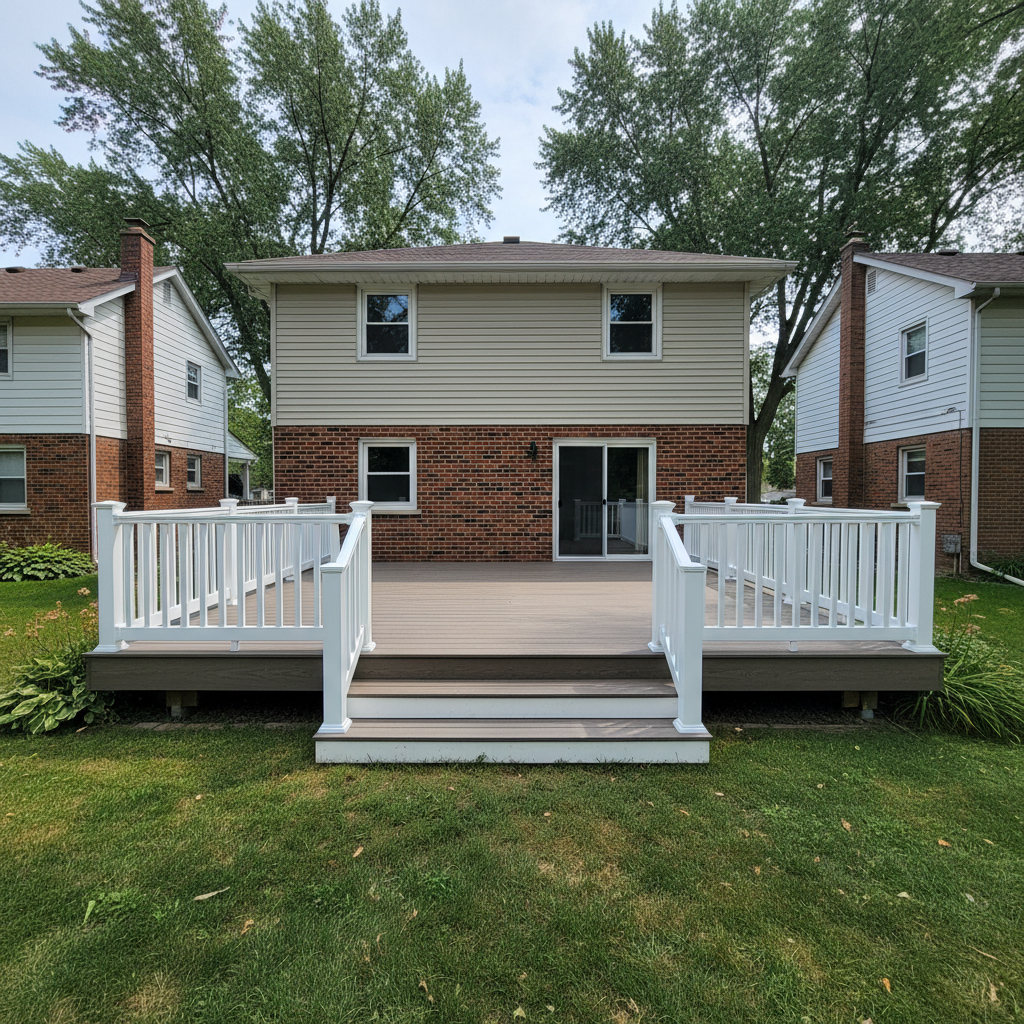
A deck is one of the few home projects where a mistake doesn't show up right away. The footing can be short of frost depth and you won't know it until the third or fourth winter, when the posts start heaving and the railing wobbles. So picking the right builder matters more here than it does for, say, repainting a bedroom.
Ask about the footings before you ask about the decking
Everyone wants to talk about Trex colors and railing styles first. Ask about what's going in the ground instead. In Racine County, frost footings generally need to go down around 42 inches to get below the frost line. Short that depth, even by six or eight inches, and you're relying on luck through a Wisconsin winter. The clay-heavy soil common through this area doesn't help matters. It holds water, and when that water freezes and expands, it pushes against anything sitting above the frost line. A footing poured too shallow doesn't fail the day it's poured. It fails slowly, one freeze-thaw cycle at a time, and by the time you notice the deck has a lean to it, you're looking at tearing out concrete, not tightening a bolt.
A builder who's done this a while will tell you the footing depth and the post size without being asked twice. One who shrugs and says "we usually just go a couple feet" hasn't been paying attention to what actually happens around here come March.
Permits aren't paperwork you can skip
Most deck construction in the City of Racine needs a building permit, and that's true in the surrounding townships as well, though the process runs through the local building department rather than the city in unincorporated areas. The inspector typically wants to see the footing holes before concrete goes in, and then comes back for a final look once the structure is up and the railing's attached. A contractor who tells you permits are "optional" or "only for the big jobs" is either wrong or hoping you don't check. Skipping the permit doesn't just risk a fine. It means nobody with a code book ever looked at your footing depth, your ledger attachment, or your railing height before you started using it.
If you're in one of the newer subdivisions out toward Mount Pleasant or Caledonia, check your HOA covenants too. A lot of those developments have their own rules on deck height, materials, or how close you can build to the property line, separate from whatever the township requires.
The ledger board is where most failures start
If the deck attaches to the house, the ledger board is the single most important connection in the whole structure. It's also the one most often done wrong. Lag screws driven into the band joist without proper flashing will let water run down behind the board for years before anyone notices the wood's gone soft. The fix is flashing that directs water out and away from the house, and fasteners sized to actually carry the load, not just hold the board up while the crew works. Ask how the deck will attach to the house. If the answer is vague, that's a problem, because this is the detail that decides whether the deck pulls away from the house in a windstorm or just sits there for thirty years doing its job.
Materials and fasteners that actually match each other
Almost all pressure-treated lumber sold today uses a copper-based preservative, ACQ, and that copper reacts with standard galvanized steel. Use the wrong fasteners or joist hangers and you'll get corrosion working from the inside, invisible until a hanger fails. Hot-dip galvanized or stainless fasteners cost more upfront and they're the only ones that belong in treated lumber. If composite decking is on the table, ask about expansion gaps. Composite boards move with temperature the way wood doesn't, and a deck built tight in July without room to expand can buckle by the following summer. Racine sits close enough to the lake that humidity swings are real, and the freeze-thaw pattern here runs through most of the winter, not just a couple of hard cold snaps. Materials and fasteners need to be picked for that, not for whatever was cheapest at the lumber yard that week.
What should make you walk away
- No mention of a permit, or a quote that doesn't separate the permit cost from the labor
- A price far below every other bid, with no explanation for the gap
- No proof of insurance, or a reluctance to give you a copy
- A contract that's really just a handshake and a number on a napkin
- Someone who pushes you hard toward one material without asking what you actually want out of the deck
None of these alone means a builder is bad at the work. Together, they tell you how much trouble you'll have if something goes wrong in year two.
Older neighborhoods closer to downtown Racine, places like West Racine or around Douglas Park, often have narrower lots and houses built in the 1920s through the 1950s, which means more surprises underground, old concrete, buried drain tile, sometimes an old slab nobody told you about. Newer builds out toward Sturtevant tend to be more straightforward, but the clay soil doesn't care how old the house is. Whoever you hire should be able to talk through both situations without blinking. That's generally a decent test of whether you're talking to someone who's actually done this work around here, or someone reading off a sales sheet. You can see more of how we approach that work at Fortis Deck Builders.